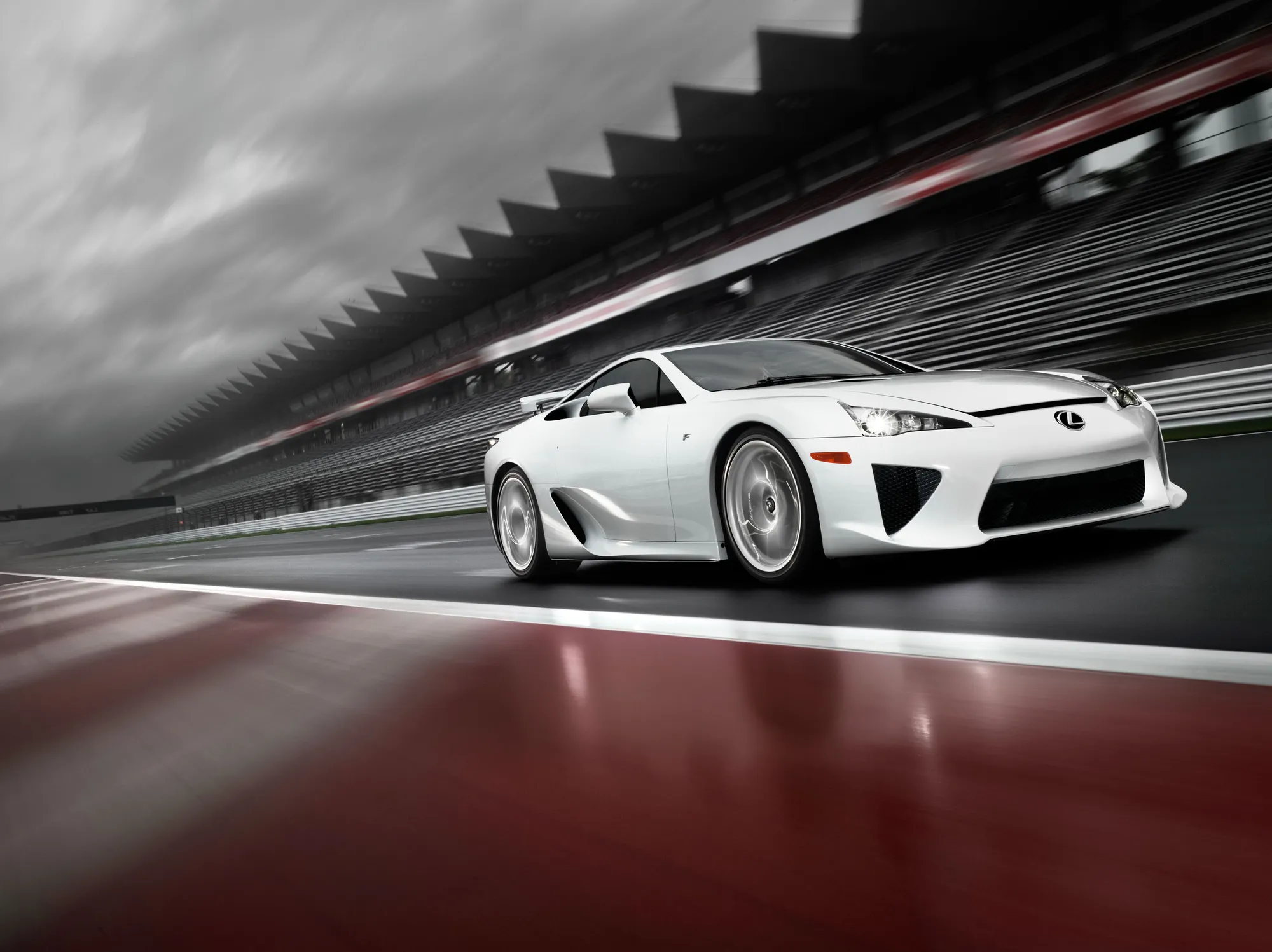
Photo: Lexus The number that explains the Lexus LFA is not its price or its power. It is 0.6, the seconds its V10 needed to spin from idle to 9,000 rpm with no load. That was too quick for any conventional rev counter to follow, evo explained, so Lexus drew the tachometer on a screen instead.
Getting there took Toyota a decade.
A study approved in a bar
The project diary opens on February 10, 2000, when Tetsuo Hattori, then Toyota's top vehicle engineer, approved a study of a real sports car. Chief engineer Haruhiko Tanahashi had pitched it to him in a Hokkaido bar, according to The Truth About Cars' inside account.
Lexus fills in the rest. The first prototype was finished in 2003 and lapped the Nordschleife in 2004. A design study appeared at the 2005 Detroit show, a closer-to-production concept followed in 2007, and production was confirmed at the 2009 Tokyo Motor Show. The car also raced the Nürburgring 24 Hours four years running from 2008.
Aluminum out, carbon in
The prototypes were aluminum through 2005. The team had studied a carbon-tubbed McLaren F1 and still stuck with metal, and by spring 2005 Tanahashi was torn: carbon was expensive and unproven at Toyota. What settled it, per the same account, was R&D chief Kazuo Okamoto telling him to switch to carbon fiber and bring all of its production in-house.
The finished body-in-white is 65 percent carbon fiber reinforced plastic and 35 percent aluminum, which Lexus said saved around 100 kg against an equivalent aluminum body. Drawing on Toyota's textile heritage, Lexus built new carbon fiber looms, plus a laser system to check the material. It developed the production process in-house, down to the joints between carbon and metal.
That heritage is literal. Sakichi Toyoda designed his first loom in 1890, and money from the loom business paid for the move into cars. Unlike a conventional loom, the Lexus loom is circular, so it can form fiber directly into parts such as the steering wheel.
The 1LR-GUE
The engine is a 4,805 cc V10 coded 1LR-GUE. It makes 412 kW (560 PS) at 8,700 rpm and 480 Nm at 6,800 rpm, with a 9,000 rpm redline and 90 percent of peak torque on tap from 3,700 rpm up.
Lexus UK rated it at 552 bhp and said it was about the size of a V8 while weighing about the same as a V6. The banks sit 72 degrees apart, and a dry sump lets the engine sit low in the car. There are 10 individual electronic throttle bodies and titanium valves, and Motor1 adds forged titanium connecting rods and forged aluminum pistons. Each V10 was assembled and signed off by one technician, who fitted an engraved plate.
The instruments are a color TFT display with a motor-driven ring that moves across it, and the tachometer needle is drawn on the LCD. Gran Turismo developer Polyphony Digital helped design and program it, according to evo.
What Yamaha actually did
Yamaha's role spans two companies. Yamaha Motor helped develop the engine, which has an even firing interval. Yamaha Corporation, the instrument maker, did the acoustic design through its Center for Advanced Sound Technologies, working with Yamaha Motor.
Their work is plumbing, not software. The intake surge tank acts as a sound radiator, its vibration tuned through wall thickness and ribs. A main duct carries that sound to a dashboard opening that passes engine noise but keeps the cabin airtight. A second duct is tuned to a 500 Hz resonance, and a panel balances volume and frequency. Yamaha said the car uses "no electrical or electronic sound processing."
Lexus handled the exhaust. A valve in the titanium silencer stays shut below 3,000 rpm, then opens so the gas skips the quieter chambers and leaves through three stacked tailpipes.
500 cars, one a day
The U.S. price was $375,000. Production began in December 2010, ran at about one car a day and ended when car 500 was completed on December 14, 2012.
The Nürburgring Package cost $70,000 more, plus $20,000 for matte black paint. It added 10 hp, for 562, and cut shift times by 0.05 seconds to 0.15. It also brought sport suspension, mesh wheels, stickier tires, a bigger front spoiler and a fixed wing, and Lexus announced it as a 50-car run. In August 2011 test driver Akira Iida lapped the Nordschleife in 7:14.64 in an unmodified Nürburgring Package car on its original tires, Lexus says. RM Sotheby's catalogs count more: 436 standard cars and 64 with the package.
From unsold to seven figures
The LFA did not sell itself. Orders dropped off in 2010, so Lexus let existing buyers order a second car and let dealers and executives order cars too. In August 2017 a dozen were still new dealer stock in the U.S., and five were left by April 2019, Autoblog reported. For a while it looked like a candidate for the supercars the internet forgot.
It wasn't. At RM Sotheby's Monterey sale in 2023, a 47-mile car sold for $1,105,000. At RM's Las Vegas auction that year, a 143-mile Nürburgring Package car made $1,875,000. On April 29, 2026, car 487, with 748 miles, sold on Bring a Trailer for $1.81 million, which CarBuzz called the highest recorded public sale for a base LFA.
A name without the V10
Lexus has brought the badge back. In December 2025 it showed the LFA Concept, a battery-electric sports car developed alongside Toyota Gazoo Racing's GR GT and GR GT3, with no powertrain figures or production timing announced.
The original is the opposite of the hybrid hypercars that followed it: no motors, no turbos, ten cylinders and a screen fast enough to keep up. Which of those hybrids aged best is its own argument.