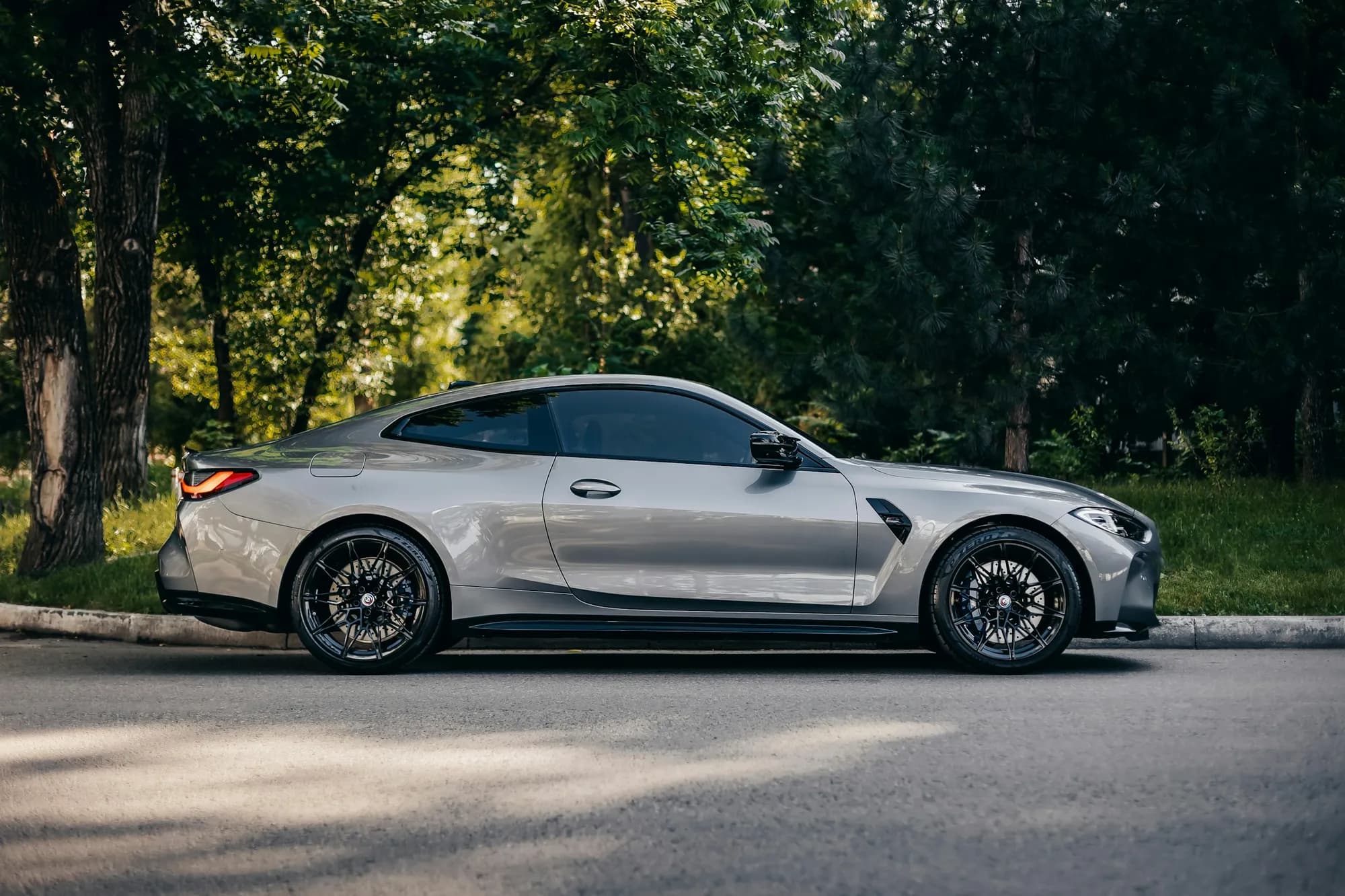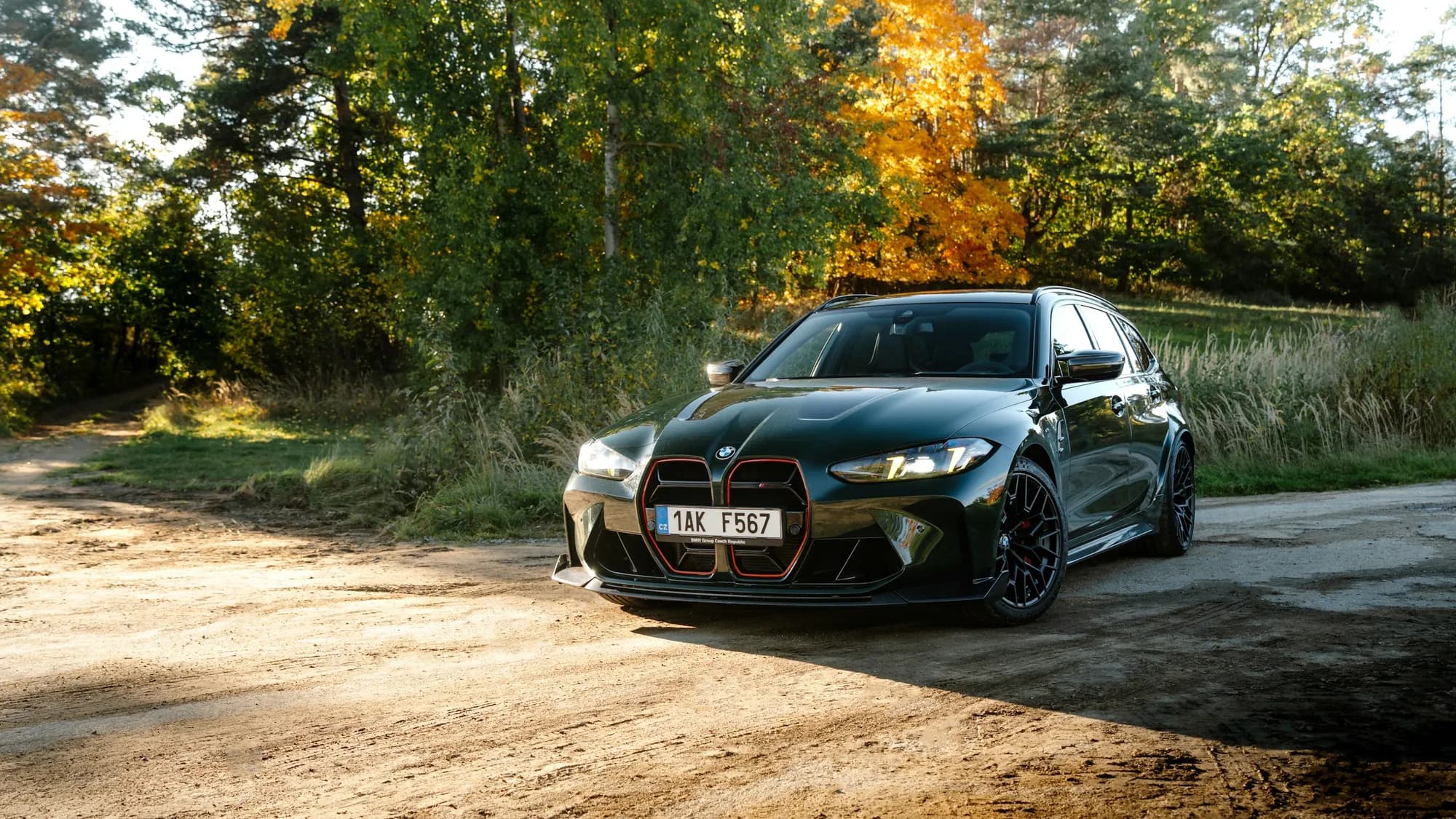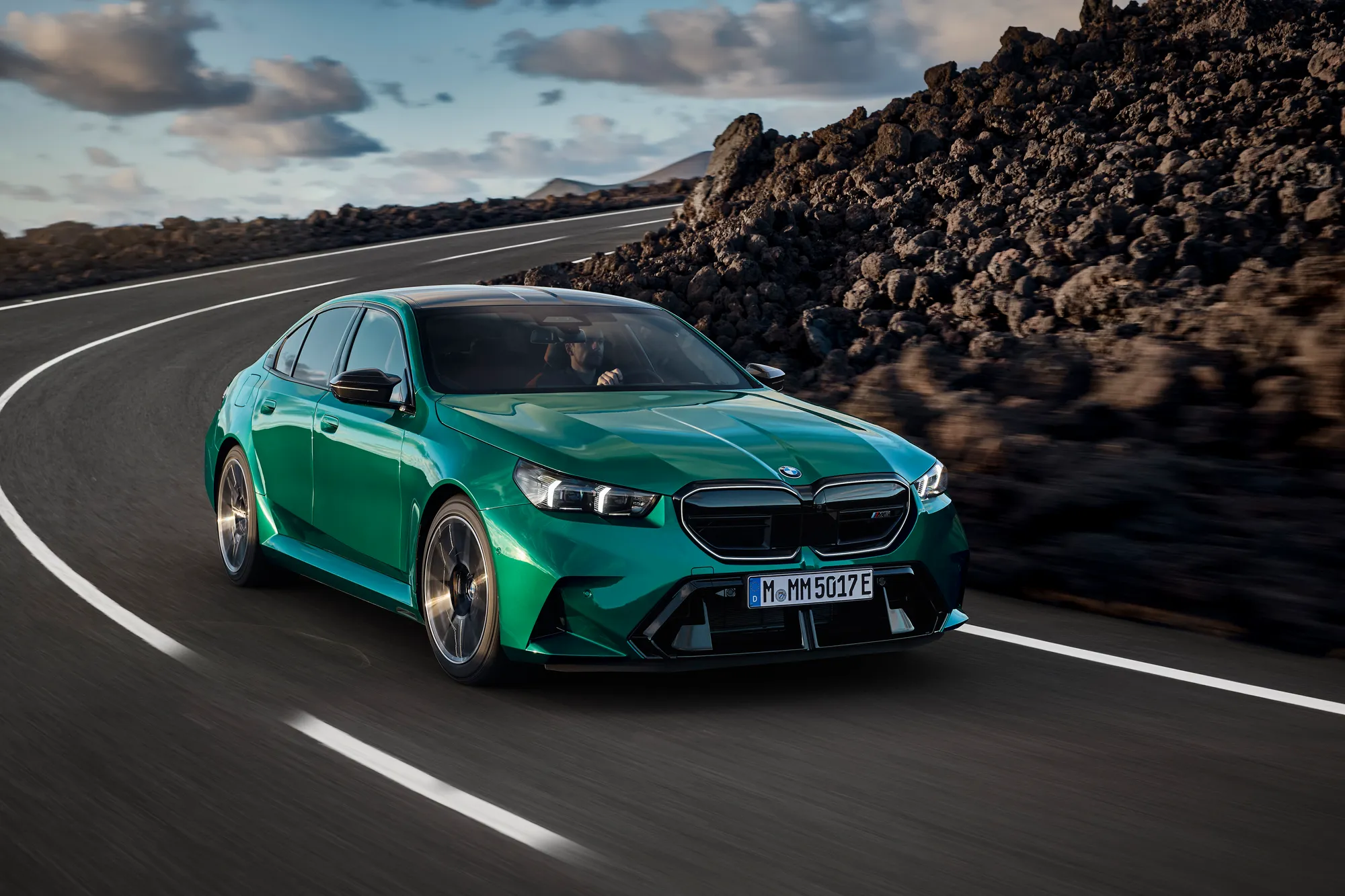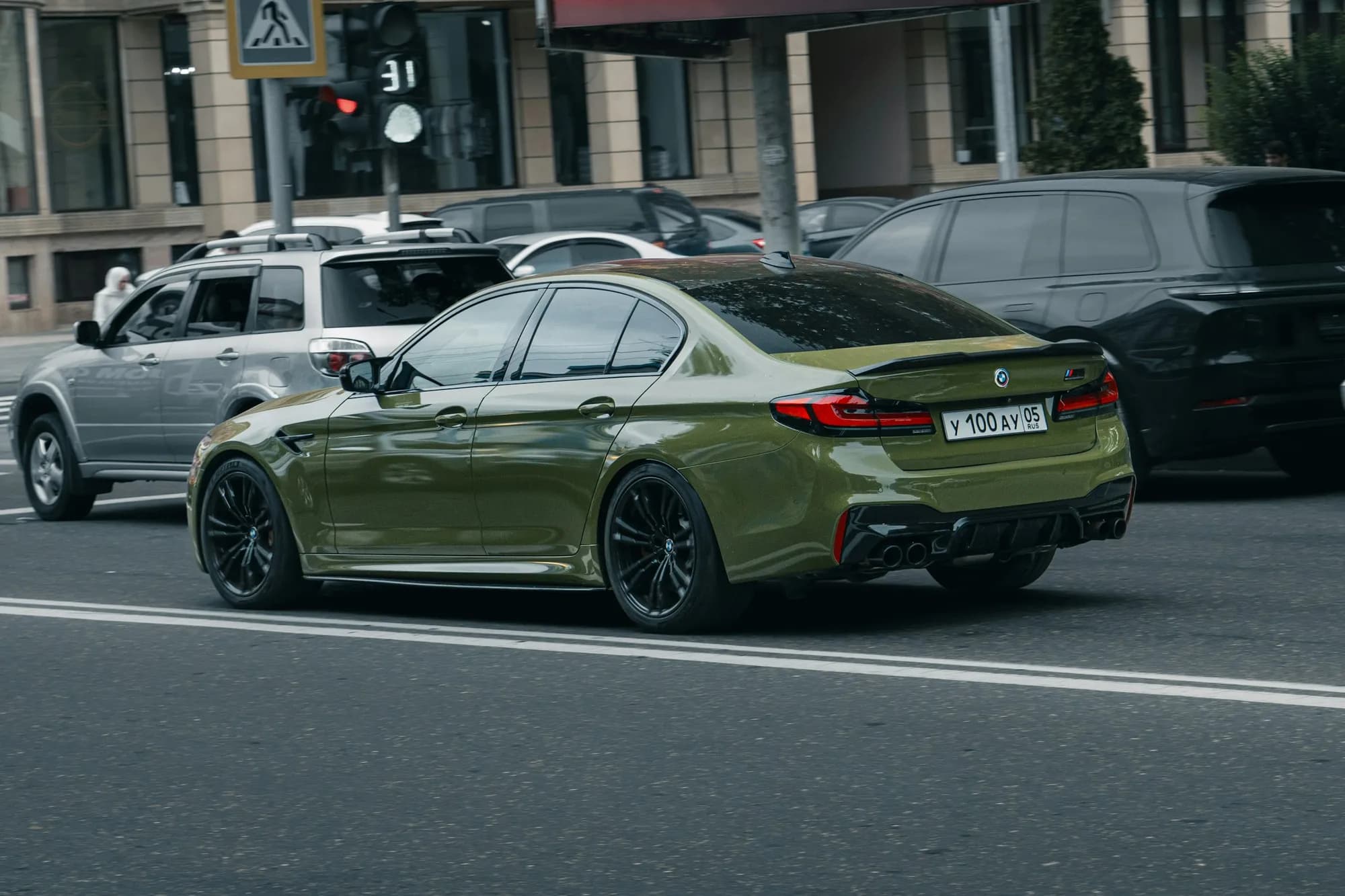
Photo: Ruslan Mingazhov / Unsplash. A BMW M5 (F90).
Every M5 before the F90 drove only its rear wheels, as PistonHeads notes. The F90 drove all four, made 600 hp in base form and, with stability control off, could hand the whole job back to the rear axle, per BMW's US launch release. It was also the last M5 without a hybrid component, built through the 2023 model year, according to BMWBlog.
That résumé is hard to argue with, and it came in four distinct versions. Here is what separates them, what goes wrong and which one to hunt.
600 hp and a front axle you can switch off
BMW rated the 4.4-liter twin-turbo V8 at 600 hp from 5,700 to 6,600 rpm and 553 lb-ft from 1,800 rpm. It claimed 0–60 mph in 3.2 seconds and a 189-mph top speed with the M Driver's Package. The car weighed 4,370 lb and was the first M5 with a carbon-fiber roof. BMW's 2018 M5 release
Where the F10 used a seven-speed dual-clutch, the F90 got an eight-speed M Steptronic torque-converter automatic, and PistonHeads reckons the car made too much torque for a twin-clutch box. BMW engineers told BMWBlog the shift times were similar, though evo still finds it sometimes hesitant on downshifts.
M xDrive is rear-biased: the front wheels join in only when the rears can't put down any more, and an Active M Differential varies its locking from zero to 100 percent. Every start defaults to 4WD with DSC on; 2WD requires DSC fully off, and BMW said it designed that mode for experienced, highly skilled drivers. In 2WD the front axle is genuinely disconnected, BMWBlog's first drive found. Our M xDrive explainer goes deeper.
Competition: stiffer in every direction
The M5 Competition entered production in July 2018 as a 2019 model with 617 hp and a claimed 3.1 seconds to 60. The bigger changes were underneath: engine-mount spring rates up from 3,312 to 5,139 lb/in, a 7 mm drop on 10 percent stiffer springs, ball joints instead of rubber mounts at the rear toe links, more negative front camber and a firmer rear anti-roll bar. It cost $110,995 including destination.
LCI: same muscle, better manners
The facelift (the LCI, in BMW shorthand), announced in June 2020 for the 2021 model year, left output at 600 and 617 hp. It added a larger kidney grille, L-shaped LED lights, a 12.3-inch touchscreen in place of the 10.25-inch unit and an M Mode button with Road, Sport and a Competition-only Track setting. The Competition got new shocks and recalibrated damper control for a more comfortable ride. BMW's 2021 M5 release BMW's international release adds that those dampers came from the M8 Gran Coupé.
CS: the M5 at full strength
Sold for the 2022 model year only, the M5 CS made 627 hp, and BMW claimed 2.9 seconds to 60, billing it as its quickest and most powerful production car yet. Carbon-ceramic brakes were standard, saving 51 lb over the M Compound hardware, and M Carbon front buckets plus two individual rear buckets made it a four-seater. Gold Bronze wheels and trim and yellow-glowing headlight tubes mark one out. It cost $142,000 plus $995.
The weight saving depends on which release you read. BMW's US figure is 230 lb less than the Competition, for a 4,114-lb curb weight; the international release says some 70 kg, about 154 lb, and lists carbon parts from the hood and front splitter to the rear diffuser.
BMW never published a final count. MDataWorks data reported by autoevolution puts the run at 1,132 cars, 454 of them for the US, about half in Frozen Deep Green. evo made the CS its 2021 Car of the Year, and its February 2026 review headline calls it "still the undisputed king of supersaloons."
Why it looks like the peak
The G90 that replaced it is the first electrified M5, rated at 717 hp combined, but it weighs 5,390 lb and claims 3.4 seconds to 60. By BMW's US figures and our arithmetic, a CS is 1,276 lb lighter and half a second quicker on paper, and even a 4,345-lb LCI Competition undercuts the G90 by more than 1,000 lb. Our G90 explainer covers what the hybrid gives back. If mass is the enemy, the F90 is where the formula peaked.
What goes wrong
Start with recalls. PistonHeads lists 2018 and 2019 campaigns for transmission wiring harnesses that could short (possibly only on US cars, it thinks) and high-pressure fuel pumps that weren't always secured properly, risking cracks and leaks, plus a 2018 fix for fuel gauges that read high. It also reports low-pressure pump faults that made some engines die on a restart after a drive; a new pump cured it. Check recall status on the VIN; our used-BMW budgeting guide covers how.
BMWBlog's 2026 used review rates this final S63 as the engine's most reliable version but names the low-pressure fuel pump, coolant tank and ignition coils as common failures. evo notes other long-term test M5s suffered a fuel-pump failure and a faulty front differential, and PistonHeads relays owner reports of front-end clunks with no confirmed cause. None of it comes with failure rates, but it tells an inspector where to look. See also BMW parts that fail like clockwork.
Maintenance that matters
PistonHeads lists oil every year or 10,000 miles, a cabin filter every 20,000, engine air filter and spark plugs every 30,000 and differential fluid every 50,000. Ask for those receipts, plus any transmission and xDrive work, which evo singles out. evo also warns that misalignment wears tires and the differential, and that carbon-ceramic pads cost four figures and a full set of discs five in the UK.
Which one to buy
BMWBlog's May 2026 review put a non-Competition F90 around $50,000 and a very nice Competition near $73,000.
Pre-LCI M5 or Competition (2018–2020): the same V8 and M xDrive, with the smaller screen and, on the Competition, the original damper tune. Confirm every recall was done.
LCI Competition (2021–2023): our pick, with the M8 dampers, the bigger screen and Track mode. PistonHeads reports that owners rate it highly.
CS (2022): the trophy, priced like one. evo's February 2026 update said no UK example had sold for under £110,000, even at auction, and the carbon-ceramic bills come with it.
Buy the most complete history you can find, not the lowest price. More from the BMW desk.
Sources: BMW's US and international press releases, evo, PistonHeads, BMWBlog and autoevolution. TUNERS has not driven or inspected these cars.