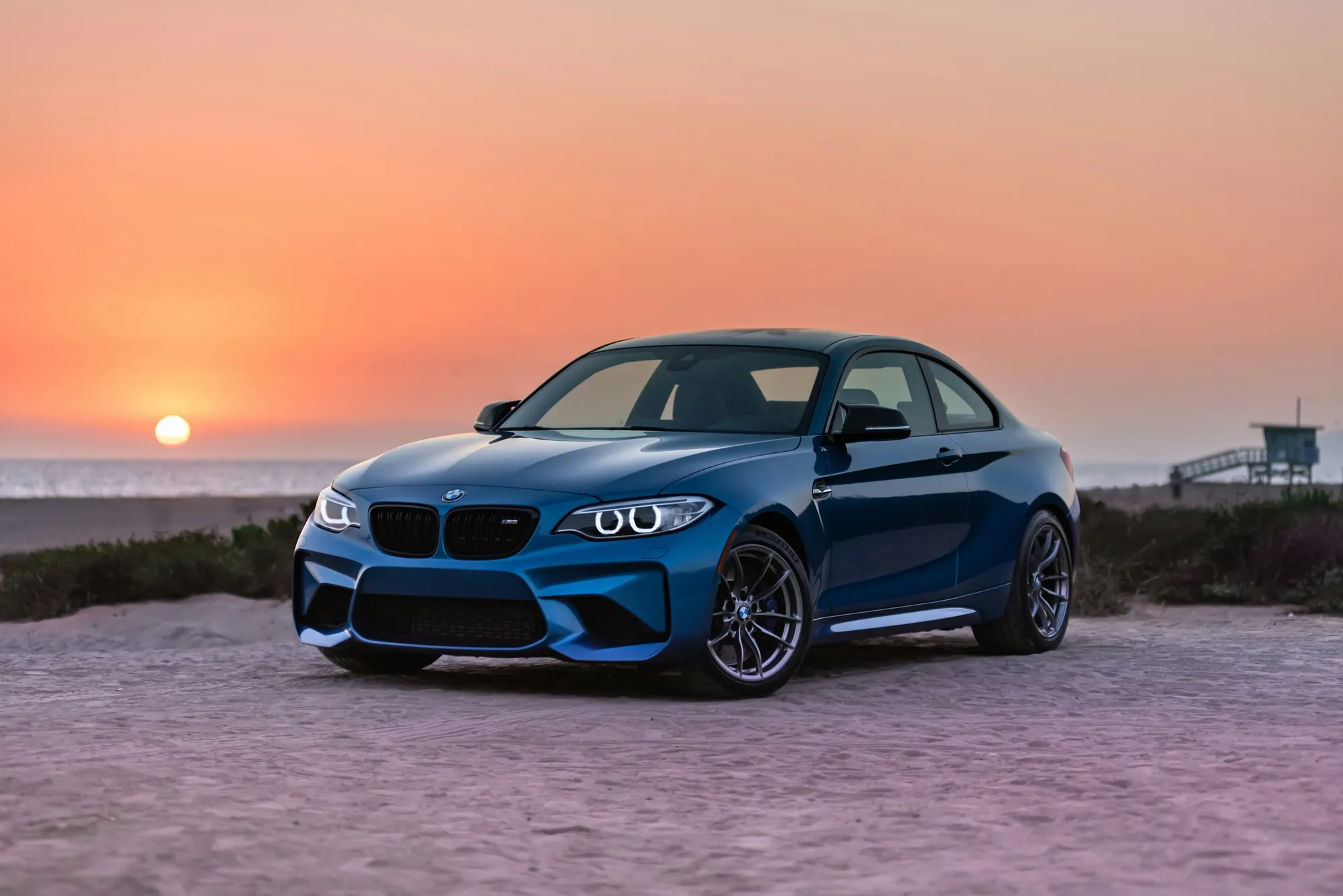
Photo: Tyler Clemmensen / Unsplash. A BMW M2 in Malibu, California.
The G87 gets the new-car attention, but the first M2 remains an appealing place to start a build: compact, and offered with a manual in every version. It is also three different cars wearing one body. BMW launched the M2 Coupe for model year 2016, replaced it with the M2 Competition for 2019 and added the M2 CS as a one-model-year car for 2020. BMW's 2016 M2 release, 2019 M2 Competition release, 2020 M2 CS release
Shopping by price band alone hides the differences that matter. Here is what changed between the three, and what to ask about before you buy.
The original: an N55 with M3 parts inside
BMW's specification table lists the 2016 car's engine as the N55B30T0, and the release says it uses pistons and crankshaft main bearing shells from the M3 and M4 engine. US output was 365 hp at 6,500 rpm, with 343 lb-ft from 1,400 to 5,560 rpm and an overboost function that raised torque to 369 lb-ft. Supporting hardware included an additional radiator, a modified oil sump with an extra suction pump, and a transmission oil cooler on M DCT cars. BMW's 2016 M2 release
The chassis borrowed the M3 and M4's aluminum front and rear axles, and the Active M Differential could vary its locking effect from zero to 100 percent. A six-speed manual with rev matching was standard; a seven-speed M DCT was optional. BMW listed US curb weights of 3,450 pounds with the manual and 3,505 pounds with the M DCT. BMW's 2016 M2 release
Competition: the S55 arrives
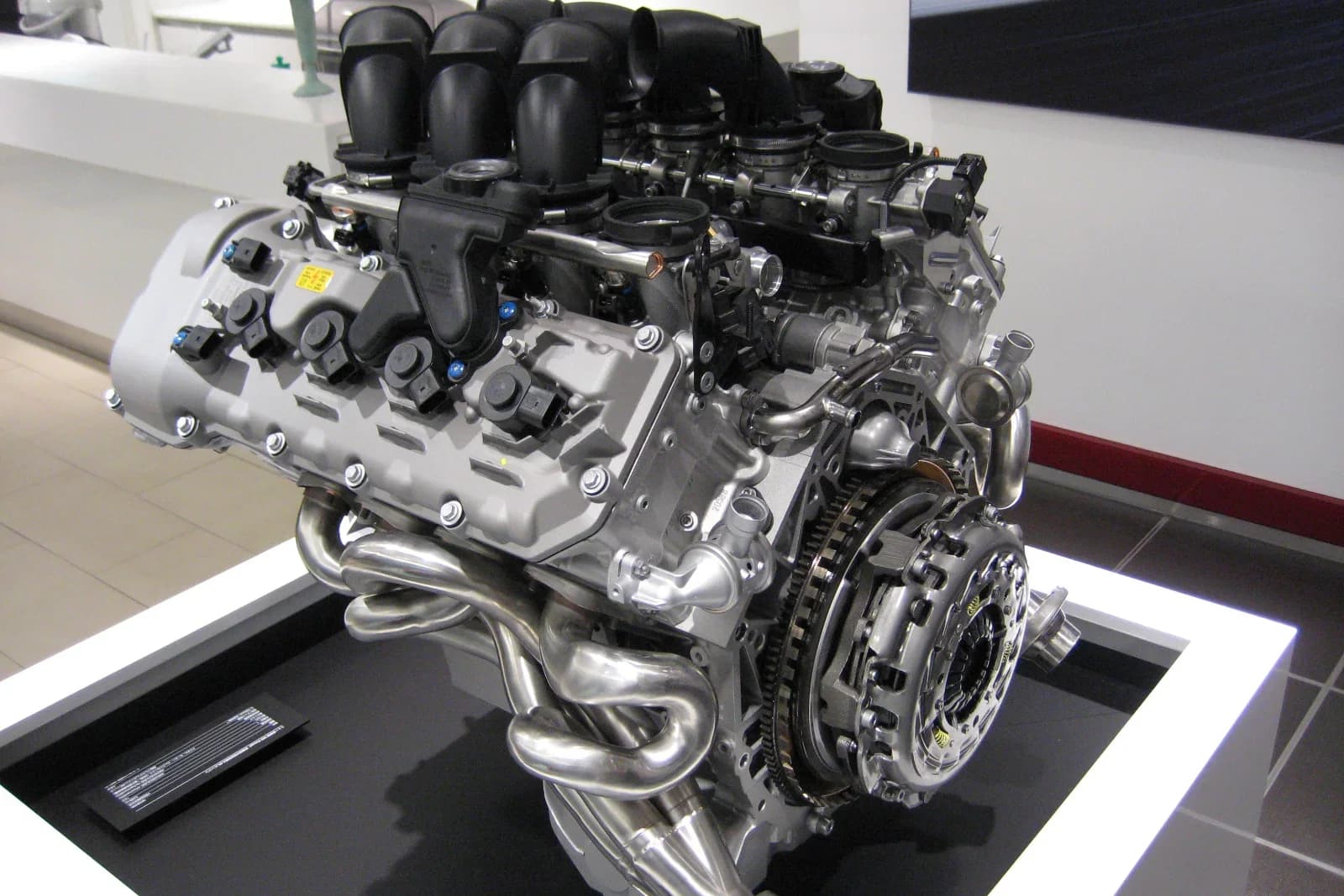
The M2 Competition took an engine based on the M3 and M4's S55: 405 hp from 5,230 to 7,000 rpm, 406 lb-ft and a 7,600 rpm redline. Cooling followed the M4 Competition Package layout, with a central radiator, two side radiators and an additional engine oil cooler, plus a transmission cooler on M DCT cars. An extra sump cover limits oil movement in quick direction changes, and an extraction pump and return system keep oil circulating under hard acceleration and braking. A carbon-fiber strut brace from the M3 and M4 stiffened the front end. BMW's 2019 M2 Competition release
The Competition is heavier by BMW's figures: 3,600 pounds with the manual and 3,655 pounds with the M DCT. Brakes need checking car by car. The release contrasts the outgoing M2's M compound brakes, with four-piston front calipers on 380 mm discs, with M Sport brakes using six-piston front calipers on 400 mm discs and four-piston rears on 380 mm discs. BMW's 2019 M2 Competition release Confirm which system a specific car carries from its build data, not its caliper paint.
CS: the factory's finished version
The CS used an uprated S55 derived from the M4 Competition, announced at 444 hp, a figure BMW marked preliminary at the time, with 406 lb-ft. Adaptive M Suspension became standard, a feature previously unavailable on the M2. The roof, hood, front splitter, rear spoiler, rear diffuser and mirror caps are carbon-fiber reinforced polymer. Standard brakes used red six-piston front and four-piston rear calipers, and M Carbon Ceramic brakes appeared as an M2 option for the first time. A six-speed manual remained standard, with the M DCT optional, and Michelin Cup 2 tires could be ordered in place of the standard performance tires. BMW's 2020 M2 CS release
The S55 crank hub question
The Competition and CS also inherit the S55 crank hub debate, and BimmerWorld says failed hubs have been reported throughout the S55 community. It describes the factory assembly as three pieces, the hub, the timing sprocket and the oil pump sprocket, plus the bolt, and warns that a hub that has spun can make the valve timing skip or jump, risking widespread engine damage. Its SSR kit combines the hub and timing sprocket, keys the sprockets together and pins them to the crankshaft, which requires drilling the crank. Installation means dropping the oil pan with the subframe and steering moved aside, and setting the timing with BMW tools. BimmerWorld lists the M2 Competition among the applications. BimmerWorld's SSR crank hub page Vargas Turbocharger Technologies offers a splined alternative that uses an interference fit instead of drilling or pins, and calls the factory hub a weak point under hard driving, aggressive shifting or higher power. VTT's crank hub article
Those are suppliers describing a problem their products solve, and neither page we read publishes failure-rate data. For a buyer, the useful step is paperwork. If a hub has been replaced, find out which part, who installed it and how the timing was verified. If it has not, put the job in the plan before adding power.
How to choose
Start with the use, not the badge. The original keeps the N55 and, by BMW's launch figures, weighs 150 pounds less than a manual Competition. The Competition adds the S55, the extra cooling and the stiffer front end. The CS adds adaptive dampers and carbon panels that are part of what its buyer is paying for, so confirm they are present, original and undamaged. All three were offered with a manual or the M DCT.
Buy the version whose factory differences you will actually use. Then spend on condition and documentation, rather than on parts that undo work BMW already did.
Buying guide based on BMW's US launch specifications and suppliers' published product information. TUNERS has not inspected, driven or tested any of these cars or parts.