Photo: Toyota In June 2021, an orange 1994 Toyota Supra sold for $550,000 at Barrett-Jackson's Las Vegas auction. It had a four-speed automatic and a body kit, and it was offered as the car Paul Walker drove in The Fast and the Furious and its sequel.
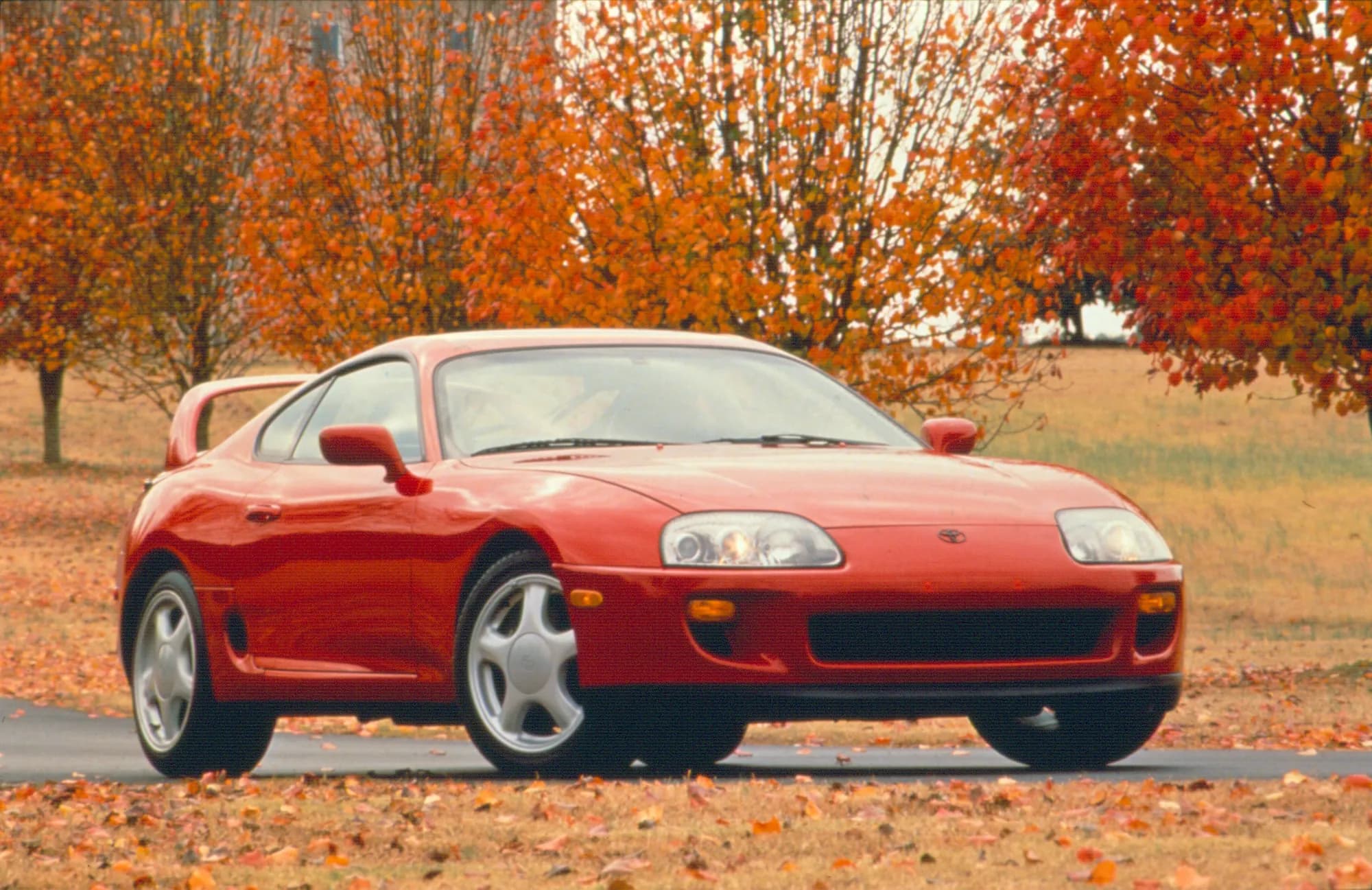
That sale is the loudest number in the A80's story, not the most useful one. Underneath the fame sits a twin-turbo flagship, built from 1993 to 2002, whose specification changed with the market and the model year. Here's how to tell them apart.
Toyota put its flagship on a diet
Toyota announced the new Supra in Tokyo on May 24, 1993, with a naturally aspirated SZ and two twin-turbo grades, the RZ and GZ. It said the car weighed more than 100 kg less than its predecessor despite added equipment, thanks to an aluminum hood, a plastic fuel tank, hollow-fiber carpet, a single exhaust and even a hollow resin rear spoiler.
The hardware was serious: double wishbones at all four corners, Bilstein dampers on the RZ and, on the turbo cars, four-channel ABS and a retractable front spoiler that drops above 90 km/h in auto mode and tucks away below 70 km/h. A removable aluminum roof was optional, and the old car's pop-up headlights were gone.
Two turbos, one at a time
In Japan, the 2JZ-GTE made 280 PS at 5,600 rpm and 44.0 kg-m at 3,600 rpm, while the naturally aspirated 2JZ-GE made 225 PS. Toyota called the turbo setup a "two-way twin-turbo."
In 1993, Toyota engineers explained that the engine selects a turbo unit to suit low or high engine speeds, using ceramic turbine wheels, to sharpen response and spread usable torque across the rev range. In practice, one turbo does the work at low revs and the second joins as they climb.
One car, three markets
- U.S.: Toyota rated the Turbo at 320 hp, good for 0-60 mph in under five seconds and a limited 155 mph. The non-turbo made 220 hp until VVT-i lifted it to 225 for 1998.
- U.K.: 326 bhp, on sale from 1993 to 1996. Export cars were retuned with different turbos.
- Japan: the 280 PS rating held, but torque rose to 46.0 kg-m with the August 1997 update; a six-speed RZ weighed 1,510 kg and listed at ¥4,480,000.
The U.S. model years have quirks worth knowing. For 1996, the Turbo came only with a four-speed automatic. The six-speed returned for 1997, when every Supra was sold as a 15th Anniversary Limited Edition. For 1998, limited-slip differentials became standard, but Turbos weren't offered in California-emissions states, and the Supra was gone from the U.S. lineup for 1999. Japan kept building it until 2002.
What the movie did to the price
The car sold in 2021 was built for the first film by The Shark Shop in El Segundo, California. It wore Lamborghini Diablo Candy Orange pearl paint with Troy Lee's "Nuclear Gladiator" graphics, a Bomex kit, an APR wing and 19-inch Dazz wheels. For 2 Fast 2 Furious it became "Slap Jack's Supra," then went back to its original look.
The money followed the fame. In 2015, Mecum sold a non-turbo 1993 Supra stunt car from the first film for $185,000. The $550,000 car still ranks second among the most expensive Supras sold at auction, behind only the first 2020 GR Supra, a $2.1 million charity sale.
Stock cars have set records of their own. In June 2022, a 1998 six-speed Turbo in Quicksilver, one of 24 in that color, with 22,962 miles, drew a $265,000 high bid plus a 15 percent buyer's premium. Massachusetts prosecutors had seized it in a 2020 marijuana investigation.
The market in 2026
The biggest sales show what wins. An unmodified, final-year 1998 Turbo made $242,000 at Mecum's Kissimmee sale in January 2026, and a one-owner black 1994 six-speed with about 13,000 miles brought $232,000 plus a $5,000 fee in September 2022. Most of the stock cars among the top sales are low-mile Turbos, several of them single-owner, and twin-turbo cars often sell for six figures.
That makes the paperwork part of the value. Confirm the market, gearbox and engine from documents rather than badges before comparing any car with those results.
Importing is the other route. U.S. rules require imported cars under 25 years old to meet federal safety standards, and because Japanese production ran into 2002, the youngest Japan-market cars won't reach 25 until 2027.