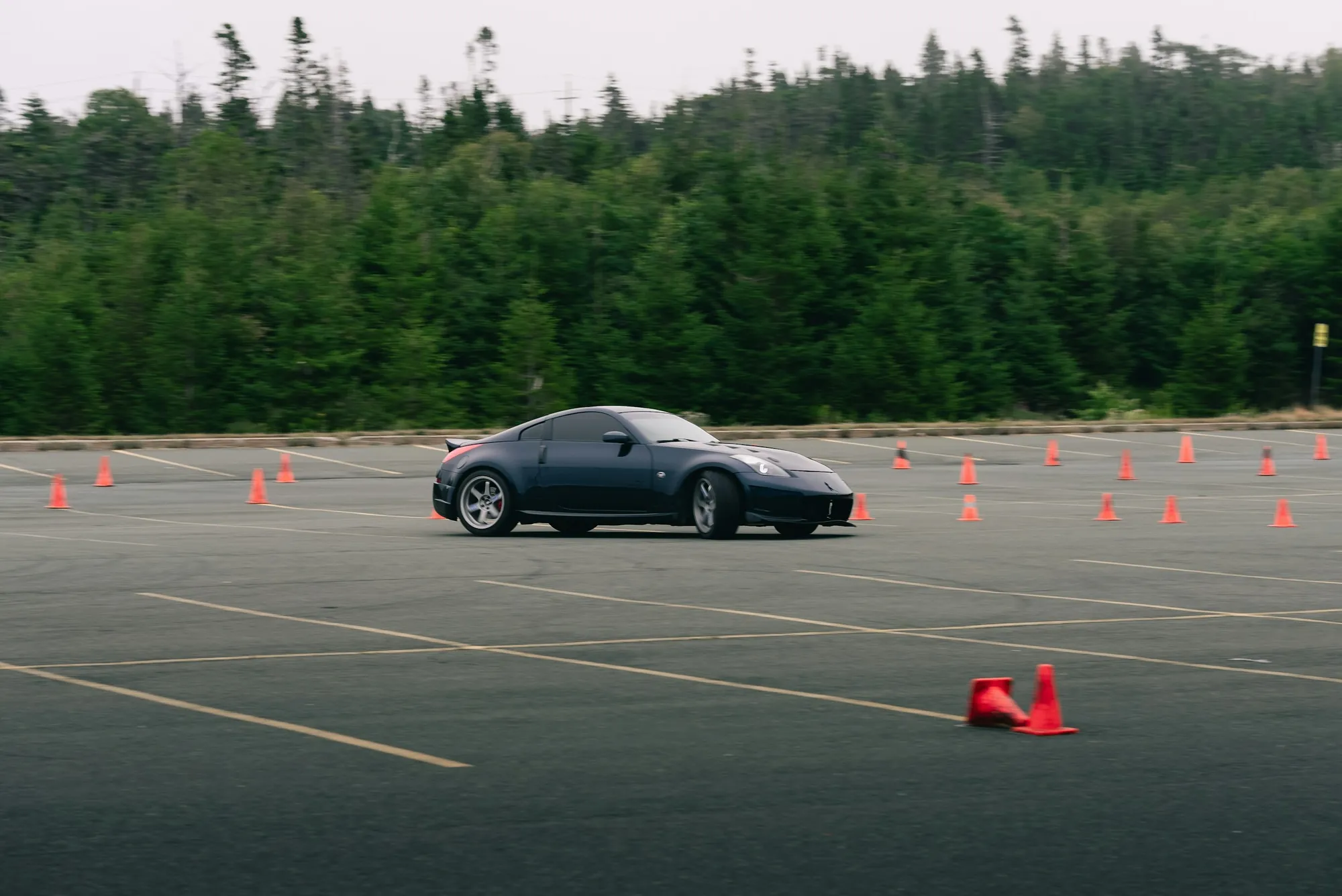
Photo: Erik Mclean / Unsplash. A sports car threading the cones on an autocross course.
Autocross is timed driving without a racetrack: a parking lot or airfield, a course marked out with cones, one car at a time and a clock deciding the result. The SCCA describes autocross as a low- to medium-speed car control event, and the format has its own logic that is worth learning before you show up. SCCA's autocross FAQ
What a run looks like
SCCA says its courses are designed not to exceed normal highway speeds. Most cars stay in second gear and top out around 55 to 60 mph, a typical course takes 40 to 60 seconds, and cars are released every 20 to 30 seconds. There are no practice sessions, so walking the course on foot is part of the job. SCCA's autocross FAQ
The vocabulary is mostly about cone patterns. A gate is two cones you drive between. A slalom borrows its name from skiing, a Chicago box is a short slalom disguised as a box, and offsets ask for alternating left and right turns. Cones lying on their sides are pointers that show which side of a standing cone to take, and hitting a pointer is not scored. SCCA's autocross glossary
How the clock and the cones score you
Raw time is the unadjusted time through the course. A cone knocked over or pushed out of its chalk box adds two seconds; one that rocks back and stays in its box costs nothing. Passing a pointer on the wrong side is a DNF, which some regions record as off course, and a run that skips part of the course posts no time. A red flag, a timing problem or a cone found out of place earns a re-run. SCCA's autocross FAQ SCCA's autocross glossary
Comparing different classes takes an index. SCCA's glossary describes RTP, or Racer's Theoretical Performance, as a factor multiplied against a driver's time to balance the classes, and notes that PAX, the system it replaced, survives as informal shorthand. The fastest time of the day after that adjustment is called FTP. SCCA's autocross glossary
National Tour events show how the scoring scales up. Drivers get three runs on each of two courses, the best run on each counts, and the two are added together, timed to the thousandth of a second with the same two-second cone penalty. SCCA's National Tour page
Classes follow preparation
SCCA's categories are defined by how much preparation is allowed, and each is split into classes, with the rulebook deciding where a particular car lands. The glossary summarizes the category ladder this way:
- Street: a few minor modifications, such as performance shocks, one non-standard sway bar and a cat-back exhaust, on DOT tires with a treadwear grade of at least 200.
- Street Touring: basic suspension changes such as coilovers and sway bars plus limited power adders, with the engine, emissions equipment and transmission left stock, on the same 200-treadwear minimum.
- Street Prepared: more freedom and DOT-legal R-compound tires, while the interior, lights and road equipment stay.
- Street Modified: engine swaps, supercharging and turbocharging, with minimum weights set by displacement and induction. These are the fastest cars on DOT tires.
- Prepared and Modified: fully prepared competition cars and highly modified production cars, and the only classes allowed to run racing slicks.
Know that ladder before you buy parts. Coilovers appear in the glossary's Street Touring allowances rather than its Street description, so a common first modification can change where a car belongs. The governing document is the 2026 Solo Rules, updated January 27, 2026, and SCCA's rules page also links an unofficial car classifier and its Fastrack updates. SCCA's Solo rules page Regions can create classes that suit local interest, and many run novice classes so beginners are not measured against veterans. SCCA's Regional Solo page
From the local lot to Lincoln
Regional events are the foundation. SCCA says many of its 116 regions run local events, and that they account for most of its roughly 1,100 sanctioned autocrosses and 77,000 entries a year. Many are small, with perhaps a few dozen people. SCCA's Regional Solo page
Above that, National Tour events run over two days with a different course each day and average more than 275 drivers. SCCA's National Tour page ProSolo starts drivers side by side, drag-race style, on mirror-image courses, and combines each driver's best run from the left and right sides. Both paths lead to Lincoln, Nebraska, home of the ProSolo finale and the Solo National Championships at Lincoln Airpark. SCCA's ProSolo page For a structured start, SCCA and Tire Rack run Starting Line, a full-day, hands-on performance driving school. SCCA's Starting Line page
Your first event
The requirements are short: a car in good working mechanical order, a valid driver's license and a helmet, with loaner helmets available in most regions. A tire pressure gauge is worth bringing too. What to bring to an autocross Volunteer inspectors check items such as seat belts, throttle return, brakes, battery security, lug nuts and loose items. If you spin, SCCA's instruction is "Both Feet In!" Up to two people can share one car. SCCA's autocross FAQ
Expect a work assignment as well. Course workers reset cones, radio in penalties and show red flags when needed, so the event runs on the people competing in it. SCCA's autocross glossary
Spend the first season in the class your car already fits, or in a novice class if your region offers one. Learn to walk a course, keep the cones standing and compare your indexed times from event to event. The parts can wait until you know which class you actually want to run in.