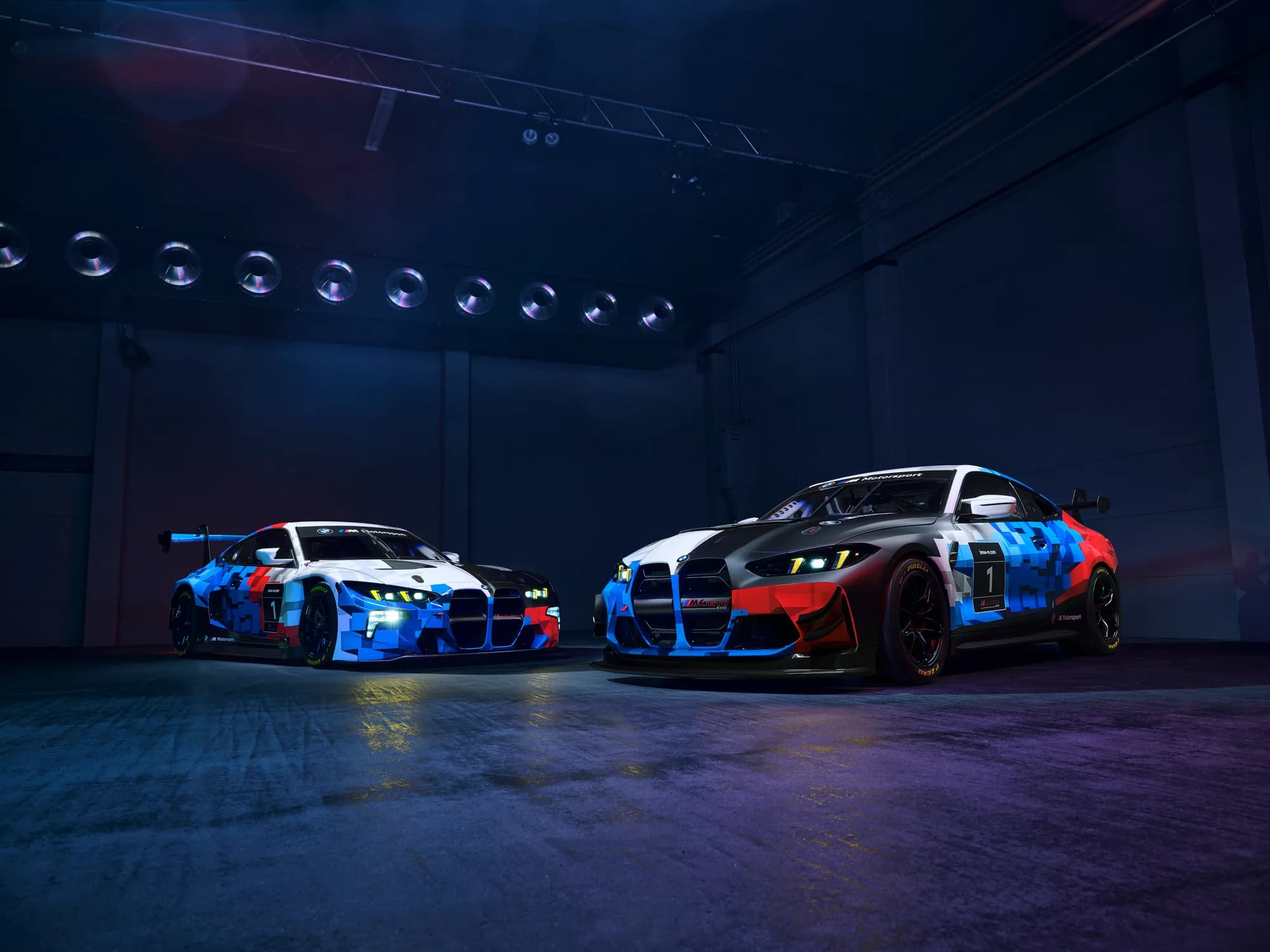
Photo: BMW AG. The BMW M4 GT3 EVO and M4 GT4 EVO.
BMW M Motorsport sells two racing versions of the current M4. Both are built around a 3.0-liter M TwinPower Turbo straight-six, both keep the same basic shape, and BMW quotes each engine's output as a ceiling rather than a fixed number. They are still very different machines, aimed at different budgets and different drivers. Putting them side by side is one of the quickest ways to understand how customer GT racing is organized.
Where the categories came from
Both categories trace back to SRO Motorsports Group. SRO's history says it presented the framework for GT3 to the FIA in 2005, and that the FIA GT3 European Championship drew grids of more than 40 cars from eight manufacturers in its first season in 2006. In 2007 SRO introduced GT4 on its own, independently of the FIA, for less powerful GT cars that sit closer to their road-going versions. In 2021 it added a GT2 series positioned between the two in cost and performance. SRO's history
The same timeline credits the FIA GT Championship with introducing Balance of Performance in 2005, when a road-homologated Maserati MC12 threatened the field. That idea, adjusting cars rather than letting one design run away, now underpins both categories. SRO's history
What changes between the two M4s
The M4 GT3 EVO, presented in May 2024 to race from the 2025 season, lists a P58 3.0-liter straight-six with up to 590 hp. It drives through an X-Trac six-speed gearbox with an electro-hydraulic clutch, stops with 390 mm front discs and six-piston calipers and 380 mm rear discs with four-piston calipers, and measures 5,020 mm long including splitter and wing. BMW priced it at 578,000 euros net. BMW's M4 GT3 EVO release
The M4 GT4 EVO uses the 2,993 cc six-cylinder at up to 550 hp and 650 Nm "depending on BoP," driving through a seven-speed ZF automatic with motorsport software. BMW listed the complete car at 219,000 euros net in June 2024, plus a 16,000-euro kit to update existing cars. Its wheelbase is 2,857 mm, 60 mm shorter than the GT3's. BMW's M4 GT4 EVO release
When the original M4 GT4 launched in 2022 at 187,000 euros net, BMW said it combined production M4 technology with components from the M4 GT3, a DREXLER limited-slip differential and 10-step traction control. It added that near-production development, together with the pending SRO homologation, would let the car race in GT4 series around the world. BMW's 2022 M4 GT4 release
The EVO updates show each car's job. BMW says the GT3 EVO work prioritized drivability, efficiency and reliability over pure performance, with new anti-roll bars, larger rear discs, aero changes and a lighter dip coating in place of paint. BMW's M4 GT3 EVO release The GT4 EVO concentrated on durability and maintenance, with a revised splitter mounting, reinforced rear wheel bearings and a steering-wheel button that switches traction control off temporarily. BMW's M4 GT4 EVO release
Why the power figures look close
Up to 590 hp against up to 550 hp sounds like a small gap, and the qualifier explains why that comparison misleads. Both categories are balanced, and BoP decides what each car actually runs at a given event. An SRO BoP sheet for a 2024 Japan Cup round at SUGO shows the levers. For each FIA GT3-homologated model, it lists a minimum weight, BoP ballast, an engine restrictor size or a reference to a boost table, minimum front and rear ride heights and a fixed lambda value. SRO describes the figures as the product of its own tests, research, analysis and projections. SRO's BoP sheet for SUGO
So the separation lies in the rest of the package and the brief behind it: an X-Trac racing gearbox in the GT3 against a ZF automatic in the GT4, a car SRO defines as closer to the road version, and a list price more than two and a half times higher for GT3.
Who drives which
Driver ratings shape the grids. GT World Challenge America explains that the FIA rates drivers Platinum, Gold, Silver or Bronze based on experience, results, age and career history rather than speed alone. GT World Challenge America on who drives GT3 Platinum describes elite, often factory-backed professionals, while Bronze covers amateurs who race for the love of it rather than as a career. GT World Challenge America on driver ratings Its GT3 classes follow those ratings. Pro lineups are typically Platinum and Gold, Pro-Am pairs a Platinum or Gold professional with a Bronze amateur, and Am is mostly Bronze drivers. All three classes start and race together, but each has its own championship and podium. GT World Challenge America on classes
GT4 America uses the same rating system with Silver, Pro-Am and Am classes. Two drivers share each 60-minute race, with a mandatory mid-race pit stop and driver change, and the series presents the GT4 platform as accessible and well supported by manufacturers. GT4 America's series explainer
When you watch, read the class marking and the driver lineup before the silhouette; two M4s on the same track may be in entirely different races. For anyone weighing a program, BMW's numbers make the ladder concrete. GT4 stays closer to the road car by design and costs far less to buy. GT3 is a purpose-built customer race car, priced accordingly. Either way, the car runs to whatever the BoP sheet says that weekend.